Yixing Teapots: How to Choose, Season, and Use Zisha Clay
- Yixing purple clay (紫砂) teapots are the most celebrated tea brewing vessels in Chinese tea culture, handmade from clay found exclusively in the Dingshu Town (丁蜀镇) area of Yixing, Jiangsu Province, which accounts for 95% of the world's purple clay production
Quick Answer
- Yixing purple clay (紫砂) teapots are the most celebrated tea brewing vessels in Chinese tea culture, handmade from clay found exclusively in the Dingshu Town (丁蜀镇) area of Yixing, Jiangsu Province, which accounts for 95% of the world's purple clay production
- Three primary clay types form the foundation of all Yixing teapots — Zi Ni (紫泥, purple clay), Hong Ni/Zhu Ni (红泥/朱泥, red clay), and Ben Shan Lü Ni (本山绿泥, native green clay) — with Duan Ni (段泥) being a blend of purple and green clays
- The global Yixing teapot market is valued at approximately ¥50 billion RMB, with Yixing's ceramic industry alone generating ¥17.1 billion in 2021 and shipping 15.46 million purple clay pieces nationwide that year
- Proper seasoning and care ("养壶") transforms a new teapot over months and years — the porous clay absorbs tea oils, developing a natural patina that enhances both appearance and brewing performance, which is why experienced tea drinkers dedicate each pot to a single tea type
A Yixing teapot isn't just a tool. It's a relationship. Buy one, use it daily for a year, and the clay changes. The surface develops a soft sheen that no amount of polishing can replicate. The tea it brews tastes different — rounder, smoother — than what comes out of a porcelain gaiwan. That transformation is why Chinese tea culture has elevated Yixing purple clay above every other vessel material for over 500 years.
But the Yixing market is also one of the most confusing in the tea world. Prices range from ¥50 factory pots to ¥500,000 master-crafted collectibles. Fake clay, misleading labels, and inflated claims are everywhere. This guide, drawn from Chinese sources including Baidu Baike, Zisha Zhijia (紫砂之家), Meihu Wang (美壶网), and Zhihu tea communities, covers what you actually need to know: clay types, how to choose a pot, how to season and maintain it, and how to avoid common pitfalls.
If you're exploring what kind of tea to brew in your Yixing pot, start with our complete guide to the six types of Chinese tea. For the brewing method most commonly paired with Yixing teapots, see our gongfu brewing guide.
A Brief History of Yixing Purple Clay
Ming Dynasty Origins
The documented history of Yixing purple clay teapots begins in the Ming dynasty. The most widely accepted origin story credits a monk from Jinsha Temple (金沙寺) in the late 15th century as the first to mold Yixing clay into a teapot. But the person who elevated purple clay from crude craft to recognized art was Gong Chun (供春), a servant to a scholar studying at Jinsha Temple during the Zhengde reign period (1506–1521). Gong Chun reportedly learned pot-making from the temple monk and produced teapots of such refinement that he's now considered the founding father of Yixing art pottery.
The timing wasn't coincidental. In 1391, the Hongwu Emperor mandated loose-leaf tea processing, replacing compressed tea cakes. This shift created demand for a brewing vessel suited to loose-leaf steeping — and Yixing clay turned out to be ideal.
Why Yixing Clay Is Special
Yixing purple clay (紫砂泥) is unique in the ceramic world for several reasons:
Double-pore structure (双重气孔). Fired Yixing clay contains both open and closed pores, giving it approximately 50% porosity. This allows the pot to "breathe" — absorbing tea aroma and oil while releasing moisture slowly. Pour boiling water into a Yixing pot and it doesn't burn your hand the way porcelain does.
No glaze needed. Unlike porcelain or stoneware, Yixing teapots are unglazed. The clay itself provides a natural, aesthetically pleasing surface that improves with use.
Mineral composition. The clay's high iron content (which gives purple clay its color), combined with kaolin, quartz, mica, and other minerals, produces a material that withstands thermal shock, retains heat well, and doesn't impart off-flavors to tea.
Geographic specificity. The clay comes from specific strata in the hills around Dingshu Town, particularly Huanglong Mountain (黄龙山). While similar-looking clays exist elsewhere, the mineral composition of true Yixing purple clay is distinct.
The Three Primary Clay Types
All Yixing purple clay ultimately derives from three base materials. Everything else — Duan Ni, Di Cao Qing, Qing Shui Ni, and dozens of other named clays — is either a subvariety or a blend of these three.
Zi Ni (紫泥) — Purple Clay
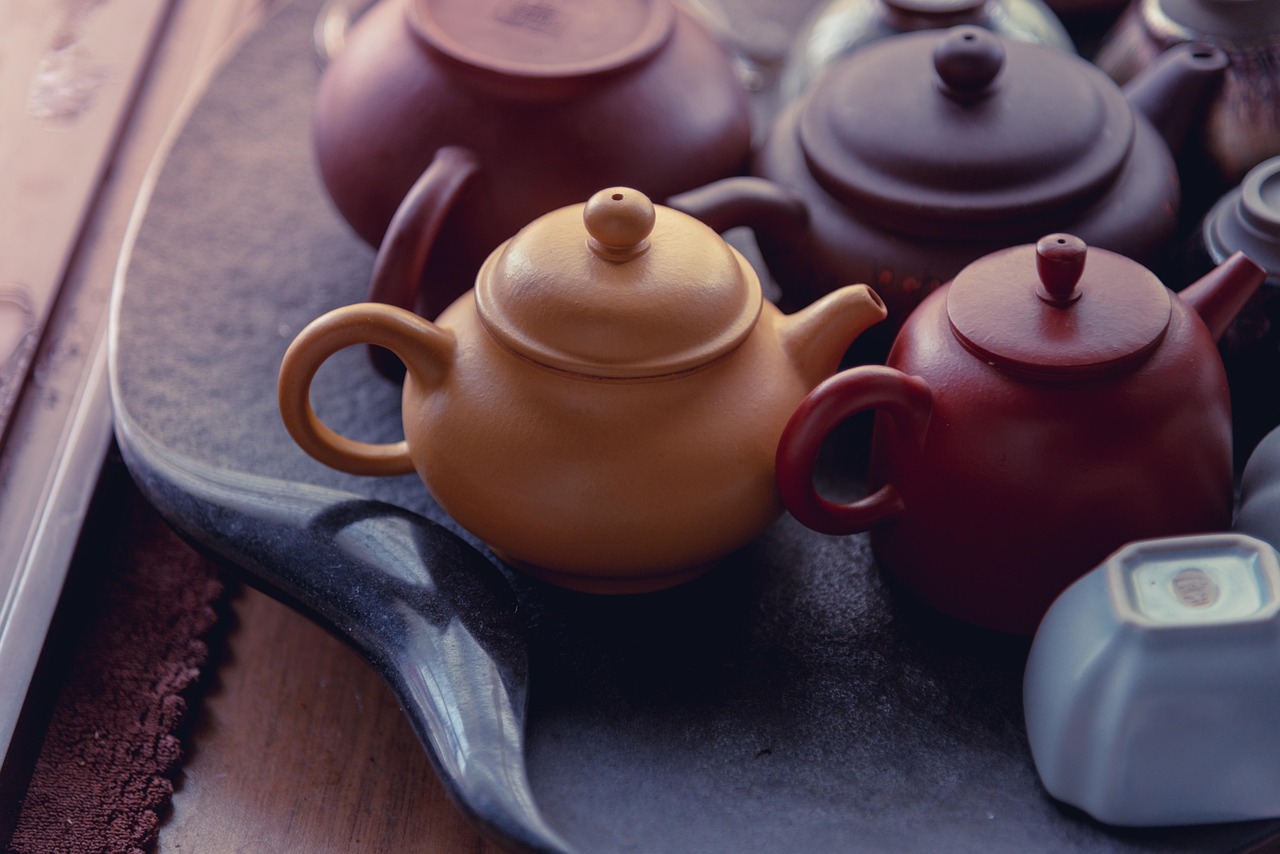
The most common and most quintessentially "Yixing" clay type. Zi Ni fires to colors ranging from deep purple-brown to reddish-brown, depending on kiln temperature and specific ore source.
Characteristics:
- Color after firing: purple-brown to dark brown
- Good plasticity for shaping
- Moderate shrinkage rate (approximately 11%)
- Excellent tea-brewing performance across all tea types
- Develops patina steadily with use
Major subtypes:
| Subtype | Chinese | Character After Firing |
|---|---|---|
| Qing Shui Ni | 清水泥 | Reddish-brown, pure purple clay without blending. The "standard" Zi Ni |
| Di Cao Qing | 底槽青 | Deep purple-red to dark brown. Increasingly rare. Considered the finest Zi Ni subtype |
| Li Pi Zi Ni | 梨皮紫泥 | Pear-skin texture, fires to a frozen pear color |
Di Cao Qing (底槽青) deserves special mention. It comes from the bottom layer of purple clay deposits and is distinguished by occasional green spots (鸡眼, "chicken eyes") visible in the raw ore. After firing and seasoning, Di Cao Qing pots develop a warm, liver-red color that collectors prize. Supply has diminished significantly as deeper deposits have been mined out.
Hong Ni / Zhu Ni (红泥/朱泥) — Red Clay
Red clay produces the brightest, most visually striking Yixing teapots. Zhu Ni (朱泥, vermilion clay) is the most prized subcategory — small, thin-walled pots in vivid orange-red that ring with a clear, high-pitched tone when tapped.
Characteristics:
- Color after firing: orange-red to deep vermilion
- Higher shrinkage rate (15–25%, compared to ~11% for Zi Ni) — making larger pieces difficult to craft without warping or cracking
- Very fine grain structure, resulting in a denser, less porous body
- Higher-pitched sound when tapped (the "紫砂金声")
- Best suited for high-fragrance teas: Dan Cong, Tie Guan Yin, high-aroma oolongs
Red clay subtypes:
| Subtype | Chinese | Notes |
|---|---|---|
| Zhu Ni | 朱泥 | True vermilion clay. Finest grain, highest shrinkage, most valued |
| Xiao Hong Ni | 小红泥 | Common red clay. Easier to work with, lower price |
| Da Hong Pao Ni | 大红袍泥 | Rare, fires to a deep red. Named after the tea (confusing, yes) |
The high shrinkage rate of Zhu Ni means success rates are low — a significant percentage of pots crack or warp during firing. This contributes to Zhu Ni's higher pricing and also explains why most Zhu Ni pots are small (under 200ml).
Ben Shan Lü Ni (本山绿泥) — Native Green Clay
The rarest of the three base types. Green clay fires to pale yellow-green or warm beige tones. It exists in thinner ore layers than purple or red clay, limiting supply.
Characteristics:
- Color after firing: pale yellow-green to warm beige
- Fine-grained, smooth texture
- Lower firing temperature tolerance
- More delicate and less forgiving to work with
- Best suited for lighter teas: green tea, light oolong, white tea
Duan Ni (段泥) — Blended Clay
Duan Ni is created by blending purple clay with green clay (and sometimes small amounts of red clay). The result fires to various shades of tan, yellow, and warm brown. Duan Ni is popular for its warm, earthy appearance but has one notable issue: it's more prone to "吐黑" (tu hei, "spitting black") — developing dark stains from tea absorption that can look unsightly on the light clay surface.
Key point for buyers: If you want a Duan Ni pot, plan to use it with lighter-colored teas (green, white, light oolong) to minimize staining.
How to Choose Your First Yixing Teapot
Step 1: Determine Your Budget
| Budget Range | What to Expect |
|---|---|
| ¥100–300 | Factory-produced, decent clay quality, basic shapes. Functional daily users |
| ¥300–800 | Better clay selection, more careful finishing. Handmade by apprentice-level potters |
| ¥800–3,000 | Fully handmade by skilled potters. Good clay, refined craftsmanship. The sweet spot for serious tea drinkers |
| ¥3,000–10,000 | Named potter work, premium clay. Collectible quality |
| ¥10,000+ | Master-level work, rare clays, exhibition pieces. Art collecting territory |
For a first pot intended for actual tea brewing, the ¥300–800 range offers excellent value.
Step 2: Match Clay to Tea
This is the most important practical decision:
| Tea Type | Recommended Clay | Reason |
|---|---|---|
| Pu-erh (sheng and shou) | Zi Ni (purple clay) | High porosity absorbs and complements pu-erh's deep flavors |
| Wuyi Rock Tea (yancha) | Zi Ni or Di Cao Qing | Heavier clay tames roasted oolongs' intensity |
| Dan Cong oolong | Zhu Ni (red clay) | Thin walls and fine grain showcase high-aroma teas |
| Tie Guan Yin | Zhu Ni or Zi Ni | Either works; Zhu Ni for aroma emphasis, Zi Ni for body |
| Black tea (hongcha) | Zi Ni | Classic pairing, mellows the tea's sweetness |
| Green tea | Lü Ni or Duan Ni | Light clay doesn't overwhelm delicate green tea flavors |
| White tea | Duan Ni or Lü Ni | Similar logic as green tea |
Critical rule: one pot, one tea type. Because Yixing clay absorbs tea oils, using the same pot for different tea types muddies both flavors. Dedicate each pot to a single tea category.
Step 3: Check Craftsmanship
Even without expertise, you can evaluate basic quality:
Lid fit (口盖). The lid should sit flush and level in the rim with minimal wobble. Rotate the lid — it should turn smoothly without catching. The gap between lid and rim should be consistent all around. This is the single most revealing quality indicator.
Spout, handle, and lid knob alignment. Viewed from above, these three points should form a straight line. Misalignment indicates careless craftsmanship.
Pour test. When you tilt the pot with the lid on and your finger covering the air hole, water should stop flowing from the spout. Release the air hole and the stream should resume smoothly. A clean, steady pour arc (not dribbling or spraying) indicates good spout design.
Sound test. Tap the pot body gently with your knuckle. Good Yixing clay produces a clear, resonant tone — not a dull thud (under-fired or impure clay) or a sharp ping (possibly mixed with non-Yixing material).
Surface texture. The clay should feel fine-grained but not glassy smooth. Under magnification or strong light, you should see subtle granular texture. A completely smooth, glassy surface suggests the pot may have been artificially polished or is not true Yixing clay.
How to Season a New Teapot (开壶)
 Source: Yunnan Sourcing
 Photo by cromagnon130 on Pixabay
Before first use, a new Yixing teapot needs to be "opened" (开壶). This removes any residual kiln dust and prepares the clay's pores.
The Simple Method (Recommended)
- Rinse the pot inside and out with clean water
- Boil the pot in a clean stainless steel pan of plain water for 30–60 minutes. The pot should be fully submerged. Place a cloth at the bottom of the pan to prevent the pot from banging against the metal
- Remove and let cool naturally. Don't shock it with cold water
- Boil again with the type of tea you plan to brew in the pot. Add a generous amount of loose leaf tea to the water and boil for another 30–60 minutes
- Remove, rinse with clean water, and let dry completely
The Traditional Method (More Elaborate)
The traditional Chaozhou method involves four boiling stages:
- Plain water boil (1 hour)
- Boil with tofu (1 hour) — the theory is that tofu's mild fat absorbs any remaining impurities
- Boil with sugarcane (1 hour) — believed to add a subtle sweetness to the clay
- Boil with tea leaves of the intended type (1 hour)
The traditional method is more ceremony than necessity. The simple two-stage method works perfectly well for practical purposes.
How to Care for Your Teapot (养壶)
"Yang hu" (养壶) literally means "nurturing the pot." It's an ongoing process that transforms a new, matte-surfaced pot into a deep, lustrous object over months and years.
Daily Care Routine
After every session:
- Empty all tea leaves
- Rinse the pot thoroughly with hot water — inside, outside, lid, and spout
- Pour a small amount of the tea you just brewed over the exterior
- Wipe the exterior with a clean, dry cotton cloth while the pot is still warm
- Leave the lid off to dry completely. Never store a pot with the lid on while still damp — this invites mold
What to use for wiping: A coarse-textured cotton cloth (粗棉布) works best. It provides gentle friction that helps develop the patina. Never use fine abrasive pads, chemical cleaners, or metal brushes.
What NOT to Do
- Don't use soap or detergent. Ever. The clay's pores will absorb the soap and your tea will taste like dish soap for months
- Don't use a dishwasher. Thermal shock and detergent will ruin the pot
- Don't handle the pot with oily or lotioned hands. Oil clogs the clay's pores and creates uneven patina
- Don't leave brewed tea sitting in the pot overnight regularly. Occasional overnight steeping is fine, but habitual neglect leads to mold and off-flavors
- Don't display the pot in direct sunlight. UV exposure can fade the clay's color over time
The Patina Timeline
| Time | What Happens |
|---|---|
| 0–3 months | Clay begins absorbing tea oils. Surface starts to feel slightly smoother |
| 3–6 months | Subtle sheen develops. The pot's color deepens slightly |
| 6–12 months | Noticeable patina. The surface has a soft, warm glow |
| 1–3 years | Rich, deep patina. The pot feels distinctly different from when it was new |
| 3+ years | The pot has "personality." Experienced tea drinkers can feel and see the accumulated character |
A well-maintained pot used daily will develop a patina described in Chinese as "温润如玉" — warm and jade-like. This is the goal.
Famous Yixing Masters: A Brief Who's Who
Understanding the lineage of Yixing pottery helps you evaluate claims and appreciate craftsmanship.
Historical Masters
Gong Chun (供春, early 16th century): The founding father. No verified works survive, but his influence established Yixing pottery as art rather than craft.
Shi Dabin (时大彬, 1573–1648): Considered the greatest Yixing potter. He refined techniques, standardized forms, and elevated the craft to its highest artistic level during the Ming dynasty. Authenticated Shi Dabin pots are museum-grade national treasures.
Chen Mingyuan (陈鸣远, late 17th–early 18th century): Master of naturalistic forms. His nature-inspired pieces — gourds, tree stumps, flowers — remain the benchmark for "花器" (nature-form) pottery.
Modern Masters
The People's Republic designated "National Craft Masters" (中国工艺美术大师) in Yixing, including:
- Gu Jingzhou (顾景舟, 1915–1996): Often called the greatest potter of the 20th century. His geometric-form pots set the modern standard. A single authenticated Gu Jingzhou pot can sell for ¥10–50 million at auction.
- Jiang Rong (蒋蓉, 1919–2008): Master of nature-form pieces, known for realistic fruit and flower designs.
- Wang Yinchun (汪寅仙, 1943–2018): Continued the nature-form tradition with innovative techniques.
The "Master" Problem
The title "大师" (master) has been diluted in the modern market. Yixing now has hundreds of people claiming various "master" designations, some of which are purchased rather than earned. The presence of a "master" label on a pot doesn't automatically mean quality. Focus on the pot itself — the clay, the craftsmanship, the firing — rather than titles.
The Science of Tea Brewing in Yixing Clay
 Photo by
 Why does tea actually taste different from a Yixing pot compared to porcelain? The answer goes beyond romance.
Heat Retention
Yixing clay's thick walls and mineral composition give it excellent heat retention. The temperature drop during a gongfu steep is slower than in thin porcelain gaiwans. For teas that need sustained heat — pu-erh, heavy-roast oolongs, aged teas — this matters. The tea spends more time at optimal extraction temperature.
Mineral Interaction
The iron, potassium, and trace minerals in Yixing clay interact subtly with tea compounds during brewing. Chinese tea scientists have measured slight differences in mineral content between tea brewed in Yixing vs. porcelain vessels. Whether these differences are large enough to affect flavor perception is debated, but experienced drinkers consistently report a "rounder" character from clay-brewed tea.
Seasoning Effect
Over time, the tea oils absorbed into the clay's pores create a thin layer that contributes flavor to subsequent brews. A well-seasoned pot literally adds something. This is why old, well-used pots are valued — and why the Chinese say that a properly seasoned pot can produce drinkable tea even with just plain water. That's hyperbole, but it captures the real phenomenon.
Breathability
The double-pore structure allows minimal air exchange during brewing. This micro-aeration may reduce certain harsh compounds while preserving aromatics. It's the same principle behind why wine tastes different in different glass shapes — the vessel isn't neutral.
Identifying Fake and Low-Quality Pots
The Yixing market's biggest problem is fakes. With the annual market value reaching ¥300 billion when including all related products, and genuine Yixing clay supplies declining, the incentive to counterfeit is enormous.
Common Fakes and How to Spot Them
Chemical-dyed clay (化工壶). Some producers add metal oxides or chemical colorants to cheap clay to mimic the look of premium Yixing ore. Warning signs: unnaturally vivid or uniform color, chemical smell when hot water is poured in, glassy surface with no visible grain structure.
Non-Yixing clay. Clay from other regions (Guangxi, Yunnan) can look similar to Yixing clay but lacks the double-pore structure. Test: pour hot water on the exterior — genuine Yixing clay absorbs water quickly; the wet area dries faster than you'd expect. Non-Yixing clay beads water more.
Slip-cast pots sold as handmade. Slip-casting (注浆成型) uses liquid clay poured into molds. It's much cheaper than hand-building. Slip-cast pots have a uniform wall thickness, interior surfaces that are perfectly smooth (no tool marks), and often visible mold seam lines. Handmade pots show slight variations in wall thickness and tool marks on the interior.
The Sound Test
Pour boiling water into the pot, then put the lid on. Genuine Yixing clay produces a "沙、哑、沉" sound — sandy, slightly muffled, and deep. If the sound is metallic, ringing like porcelain, or sharp and bright, the clay may not be authentic Yixing or may be adulterated.
Yixing Pot Shapes: A Starter Guide
Yixing teapot shapes have been codified over centuries. The three major categories:
Geometric Forms (光器 / 几何形体)
Clean lines, mathematical proportions. These showcase the potter's skill through precision rather than decoration.
- Xi Shi (西施): Named after the legendary beauty. Round, full-bodied, with a short spout. The most popular beginner shape
- Shi Piao (石瓢): Triangular profile, wide at the bottom tapering to the top. Designed for stability and efficient pouring
- Fang Gu (仿古): "Imitation antique." Low, wide, drum-shaped. Excellent for teas that benefit from a wide, flat brewing chamber
Nature-Inspired Forms (花器 / 自然形体)
Carved or molded to resemble natural objects — tree bark, bamboo, fruit, flowers. These require high craftsmanship and are often more expensive.
Ribbed Forms (筋纹器)
Surfaces divided into symmetrical segments, like a melon or chrysanthemum. Technically demanding because every segment must be perfectly even.
For a first pot, geometric forms are recommended. They're easier to clean, more versatile across tea types, and showcase clay quality without decorative distraction.
Size Guide
Yixing teapots come in a wide range of sizes. The right size depends on how and with whom you drink:
| Size | Volume | Best For |
|---|---|---|
| Extra-small | 60–100ml | Solo drinking, premium teas you want to savor slowly |
| Small | 100–150ml | 1–2 people, standard gongfu brewing. The most popular range |
| Medium | 150–250ml | 2–4 people, casual sessions |
| Large | 250–400ml | Group settings, less concentrated brewing |
| Display | 400ml+ | Decorative or collector pieces, not typically used for daily brewing |
For gongfu brewing with the standard 7–8g of tea, a 100–150ml pot is ideal. Larger pots require proportionally more tea and produce a more diluted brew per infusion.
Zhu Ni pots tend to be smaller (under 150ml) because the clay's high shrinkage rate makes larger pieces difficult to produce without cracking. If you want a Zhu Ni pot, expect and embrace the smaller size — it concentrates fragrance beautifully for aromatic teas like Dan Cong and Tie Guan Yin.
Yixing and Gongfu: The Natural Pairing
Yixing teapots and gongfu brewing were made for each other. The small volume, heat retention, and clay interaction all enhance the gongfu experience. If you're using a Yixing pot, here are the gongfu adjustments:
Warm the pot first. Pour boiling water over and through the pot before adding tea. This brings the clay to brewing temperature and ensures the first infusion isn't cooled by a cold pot.
Use the recommended tea-to-water ratio. For a 120ml pot, 7–8g of oolong or pu-erh is standard. For green or white tea, reduce to 5–6g.
Pour completely. Never leave tea sitting in the pot between infusions — it continues extracting and over-brews. Pour every drop into the fairness pitcher.
Hot water on the exterior is good. During brewing, pouring leftover hot water over the pot's exterior is a traditional practice that maintains heat and contributes to the seasoning patina.
For the complete gongfu method, see our gongfu brewing guide.
Frequently Asked Questions
How much should I spend on my first Yixing teapot?
For a genuine Yixing pot intended for daily tea brewing, ¥300–800 is the realistic sweet spot. Below ¥200, you're likely getting factory-produced pots (functional but not special) or potentially non-Yixing clay. Above ¥1,000, you're paying for named-potter craftsmanship and premium clay — worthwhile for experienced collectors, but unnecessary for someone who just wants to brew better tea.
Can I use one Yixing pot for multiple tea types?
You shouldn't. Yixing clay's porosity means it absorbs tea oils and flavor compounds over time. Using one pot for different teas creates a muddled flavor that doesn't enhance any specific tea. The traditional rule is "一壶一茶" (one pot, one tea). If you drink multiple tea types, invest in multiple pots — or use a porcelain gaiwan for your secondary teas.
My new Yixing pot has a slight "clay" smell. Is that normal?
Yes. New Yixing pots often have a mild earthy or clay smell. This is normal and disappears after proper seasoning (开壶) and a few weeks of use. However, a strong chemical smell — sharp, acrid, or metallic — is a warning sign of chemical additives in the clay. If the smell persists after boiling, return the pot.
How do I clean tea stains inside my Yixing pot?
Light staining is normal and actually desirable — it's part of the seasoning process. If you need to clean more significant buildup, soak the pot in plain hot water for several hours, then use a soft brush (a clean toothbrush works) to gently scrub. Never use soap, baking soda, or chemical cleaners. For stubborn stains, boil the pot in clean water for 30 minutes.
Is it true that Yixing clay supplies are running out?
It's complicated. The Yixing municipal government restricted mining from Huanglong Mountain (the primary source) starting in 2005 to prevent resource depletion. Some premium ore types like Di Cao Qing and Tian Qing Ni are genuinely scarce. However, significant stockpiles of raw clay exist in private hands, and some mining has resumed under regulation. The "clay is running out" narrative is partly real and partly marketing — but it is true that certain premium subtypes are increasingly difficult to source.
Related Reading
- The Six Types of Chinese Tea: A Complete Guide
- Gongfu Brewing: The Chinese Method That Transforms How Tea Tastes
- How to Store and Age Chinese Tea Properly
— The Tea Atlas Team